
When a Team Grows, CRM Assignment Breaks First
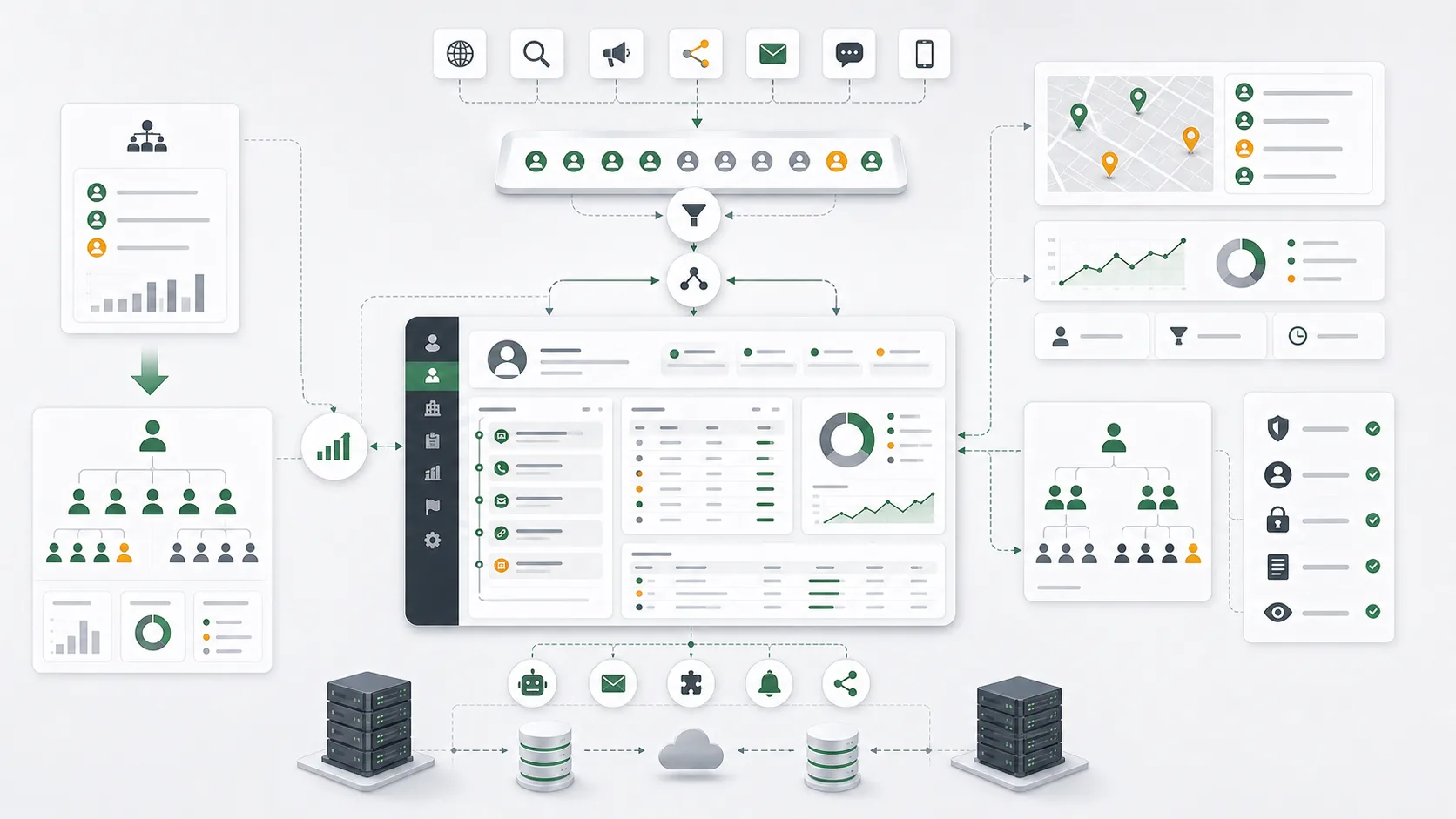
When a small team uses a CRM, many rules can live in people's heads. Who is following which customer, which lead should be handled first, and which customer has not been contacted for a long time can often be answered by asking around.
Once the team grows, that way of working fails quickly. Lead volume rises, client managers increase, and supervisors no longer care only about one customer at a time. They need to know whether the whole process is being executed. At that point, the first weakness exposed by the CRM is usually not a lack of pages. It is unclear assignment, flow, and reporting definitions.
A Lead Pool Is Not Just a List
My early understanding of a lead pool was simple: collect leads from ads and channels, then assign them to client managers. But once the system runs in a real team, a lead pool is no longer a static list. It becomes a business dispatch mechanism.
It needs to know where a lead came from, whether it is duplicated, whether someone has handled it, how long it has been idle, whether it should be recycled, and whether a supervisor can see the overall team state. The list is only the interface. The rules sit behind it.
If those rules do not enter the system, assignment depends more and more on manual judgment. That may work when there are only a few people. It creates disputes and inefficiency when the team grows.
Client Ownership Has to Be Explicit
One of the most important relationships in a CRM is the ownership relationship between a customer and a client manager.
It looks simple, but it affects many later questions: who can view the customer detail, who can write follow-up records, who is responsible for conversion, whose statistics the customer belongs to, and whether the customer returns to the public pool after a long period without follow-up.
I try not to leave customer ownership in conversations or spreadsheets. Once the team starts growing, ownership should enter the system and be usable by permissions, lists, statistics, and recycling rules.
A Manager View Is Not Just Another Page
When a team grows, a manager does not need a copy of the client manager's page. A manager needs a different view.
A client manager cares about who to follow up with today. A manager cares about which leads are untouched, whose follow-up efficiency is low, which channels produce better leads, and where the process is stuck. Both views come from the same data, but they answer different questions.
So when I design CRM workflows, I separate execution views from management views. The execution view emphasizes the next action. The management view emphasizes whether the process is healthy. Only then does the system support management instead of only data entry.
Reporting Definitions Should Stabilize Early
If CRM reporting is added too late, definitions easily become inconsistent.
When does a lead count as valid? When does it count as followed up? Should duplicate phone numbers count as new leads? Does a recycled customer count as a new assignment? Should channel quality be judged by submission volume or valid volume? If the system does not record the basic fields early, these questions are hard to answer later.
I do not think early reporting needs to be complex. But the basic definitions should be stable. Otherwise, as the team grows, people argue about numbers instead of improving business actions.
Growth Pushes System Boundaries Into the Open
This kind of CRM evolution taught me that team growth exposes system boundaries that were previously hidden. Problems solved by communication in a small team must become rules, permissions, statuses, and data in a larger one.
When I look at a CRM now, I do not only ask whether it can record customers and follow-ups. I ask whether it can handle the management pressure that appears after the team grows. Lead pools, customer ownership, assignment rules, manager views, and reporting definitions do not need to be perfect on day one, but their direction has to be thought through early.