
Message Archiving Pushes WeCom Deeper Into the System
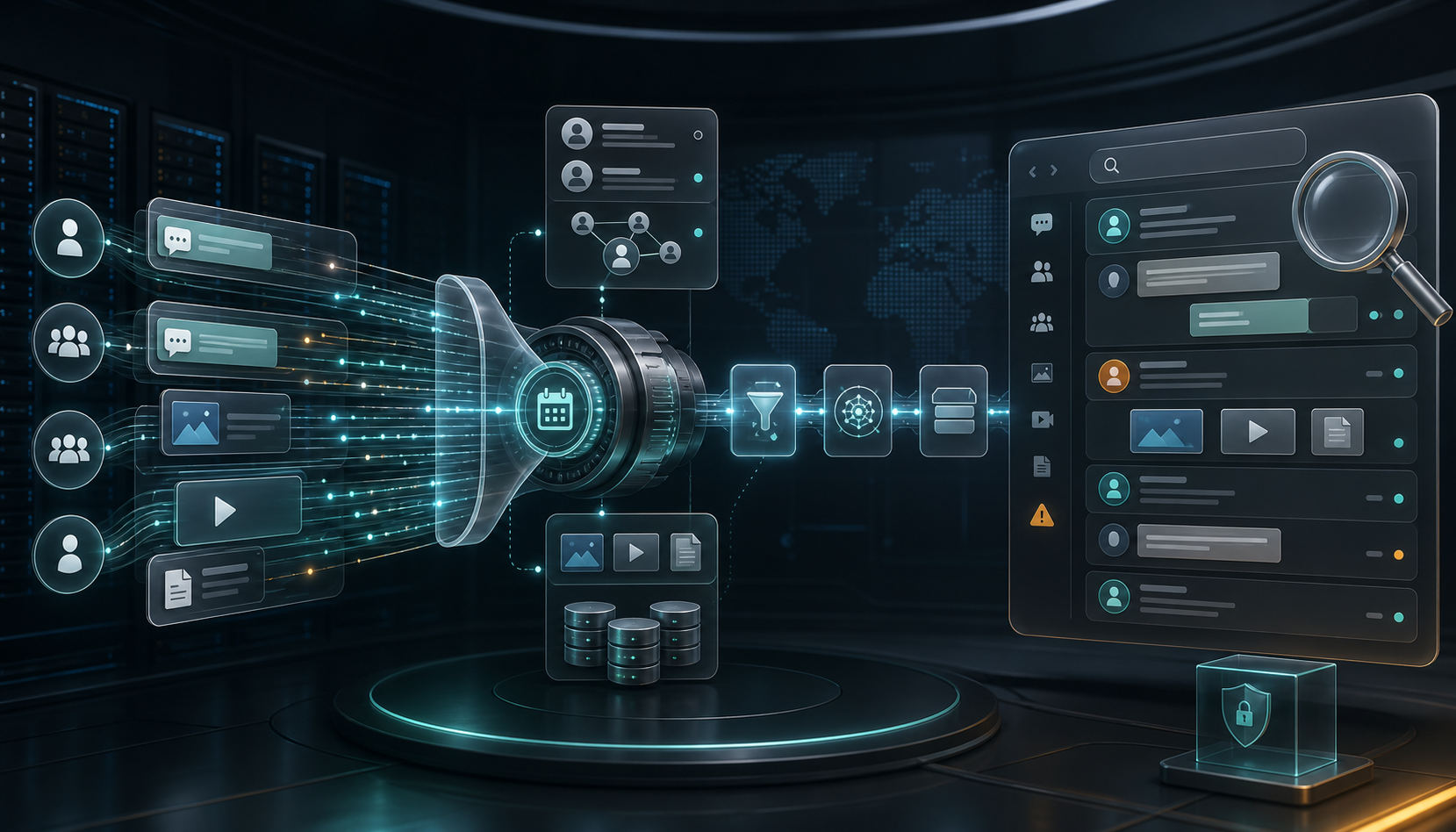
After connecting WeCom into a CRM, I quickly ran into a deeper problem. If customer communication really happens inside WeCom, it is not enough for the system to know who logged in or which external contact is currently visible in the sidebar. The valuable information is the communication process itself, and whether it can be synchronized, parsed, searched, and reviewed in a compliant way.
A message archive system is very different from login integration. Login is a one-time action. Message archiving is a continuously running data pipeline. It has to handle incremental message pulling, member enrichment, customer and room parsing, media downloads, typed message rendering, search filters, and permission boundaries. If one part is unstable, the backend only receives unreliable fragments.
Messages Have to Keep Entering the System
When I work on this kind of system, the first step is not the message list. It is making sure messages can keep entering the system reliably.
WeCom message archiving uses an incremental seq mechanism. The system needs to remember the last synchronized position and continue in batches. It is similar to reading an external log stream: it cannot start from the beginning every time, and it cannot silently skip a segment after one failure. A scheduled job needs to find the latest local sequence, pull the next batch, save the raw message, and let later steps enrich it.
The mistake is treating "message pulled" as "message done". Raw messages often contain only member IDs, external contact IDs, room IDs, or media IDs. Users want names, customers, rooms, attachments, images, voice messages, and context.
Member Enrichment Is Full of Edge Cases
The sender and receiver inside a message do not always have complete information at first.
Internal users, external contacts, customer rooms, internal rooms, and robots all need different APIs for enrichment. Some users are outside the visible scope. Some customers no longer exist. Some rooms are not customer rooms. Some robots have been disabled. The system cannot assume that every ID will cleanly become a display name.
So I treat member enrichment as its own process. Save the reliable identifier first, then let scheduled jobs fill in the missing details. This prevents message synchronization from being blocked by a failed contact lookup, while still showing which objects are incomplete.
Media Messages Need More Than an ID
Text messages are relatively direct. Images, files, voice, video, and emoji messages are harder.
When they enter the system, they often only contain sdkfileid, md5, filename, or type. The frontend cannot show that directly. The backend has to call the archive SDK, download the media, produce an accessible URL, and write that URL back into the message content. Voice adds another layer because AMR files do not behave like normal browser audio and need special handling on the frontend.
That is why I care about typed message rendering. A message list should not dump JSON. Text should expand, images should preview, files should download, links should show their title, voice messages should play, and videos should open.
Search and Dialog Reconstruction Are Different Problems
A message archive backend usually has two core actions: search messages and review context.
Search needs filters for message type, content, employee, customer, room, and time range. It answers "how do I find this message?" Dialog reconstruction is different. Starting from one message, it pulls nearby messages so the user can understand the surrounding conversation.
If the system only has search, users can find isolated messages but struggle to understand the context. If it only has conversation lists, large volumes become hard to locate. Both capabilities matter, but they solve different problems.
Message Archiving Trains Data Patience
This project taught me that after external-platform data enters an internal system, the hard part is often not the API call. It is data patience.
Some information will be enriched later. Some media files need asynchronous downloads. Some objects will never have complete details. Some message types may need degraded display at first. The system has to tolerate incompleteness without letting it turn into disorder.
When I look at a WeCom archive system now, I first check whether it has a stable data chain: messages enter incrementally, members are enriched over time, media lands somewhere usable, search can be explained, and the frontend renders different message types clearly. Only then do chat records become useful internal system data instead of external communication traces.