
How I Turned a WordPress Site Into a Business Entry Point

The first article was about how I understand the system owner role in ToB software. This one starts from a smaller and more concrete example: how a commercial website moves from being a place that displays information to an entry point that can actually support business operations.
It is easy to treat a WordPress website as a lightweight project: buy a server, set up the environment, install a theme, adjust pages, add content, and publish it. But once there is a real business behind the site, it stops being only a presentation layer. It quickly touches product maintenance, customer inquiry capture, internal handling, WeCom touchpoints, and long-term operations.
The Zhurun Investment projects were valuable to me for exactly this reason. They were not large platforms, but the delivery chain was complete: server selection and purchase, runtime environment setup, WordPress site customization, private-placement product display, consultation forms, backend product management, customer information management, WeCom touchpoint integration, and ongoing maintenance. Projects like this are a good way to observe a practical question: how can a small commercial project stay lightweight at the beginning without closing off the possibility of becoming more systematic later?
A Website Is Not a Set of Pages
The most underestimated part of a website is that it has to create external trust while also becoming the starting point for internal collaboration.
For this kind of project, visual polish is only the first layer. More important questions are whether the server is stable, whether the access paths are clear, whether content can be updated easily, whether contact channels are reliable, and whether the system leaves room for product information, consultation forms, and customer records later.
That is why I do not see WordPress customization as only page work. It is more like building the first public entry point: giving the business a visible public surface, making content updates fast, and stabilizing basic information and brand expression. At this stage, the technical choice should be pragmatic. There is no need to turn every public page into a custom application just to make the project look more engineered.
But the opposite is also true: not every business process should be forced into WordPress. Once structured products, consultation forms, backend handling, and customer touchpoints appear, content management and business workflow should be separated. The website handles expression and entry. The business system handles data and process. The earlier this boundary is clear, the less confusion there is later.
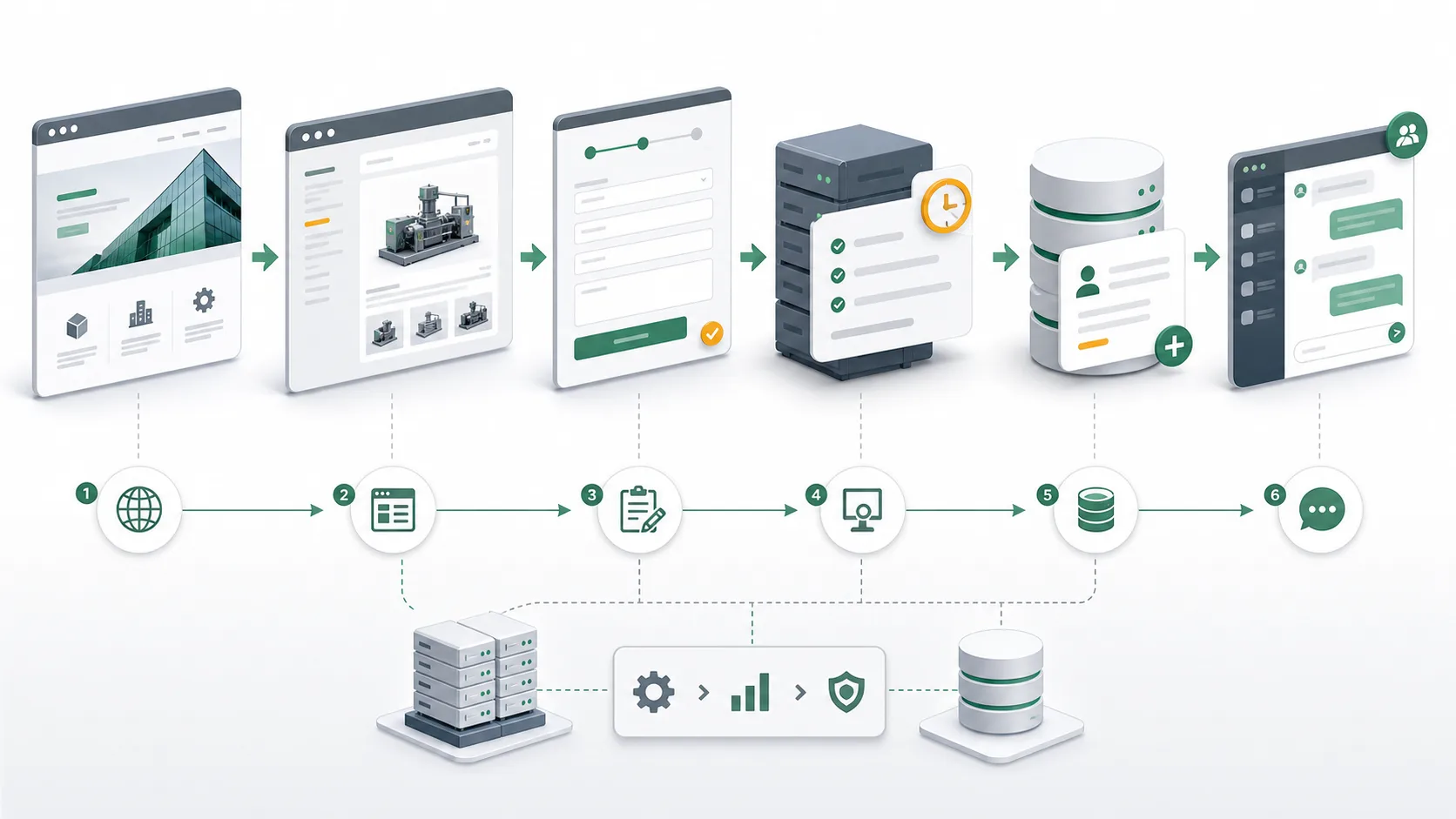
When Visits Become Inquiries, System Boundaries Appear
The Zhurun product system appeared exactly at this boundary.
Looking back at the system, I see it less as an overdesigned platform and more as a lightweight business system around private-placement product display and consultation handling: the customer side had the home page, product list, and consultation entry; the management side had product categories, product management, consultation-form review, and system users; the WeCom sidebar could read external contact information and connect it with customer records.
The system used Laravel 9, Inertia.js, React, and Ant Design. For this type of project, the tradeoff is clear: Laravel handles routes, permissions, models, and backend business logic; React makes backend interaction more flexible; Inertia connects the two without forcing a small or midsize system into the full operational cost of a separate frontend and backend.
What mattered more than the stack itself was where the data came from and where it went.
When a customer reads product information and submits a consultation request, the form data should not stop at an email or a site notification. It needs to enter the backend so internal staff can review it, mark it, and continue handling it. If later customer communication happens through WeCom, the system should also have a way to connect that touchpoint with the customer record. In that sense, a website visit becomes a business lead rather than an isolated page view.
Small Projects Still Need Future Structure
A common problem in small commercial projects is that speed in the early stage turns everything into a one-off solution. Pages are hardcoded, forms only send emails, customer information sits inside chat histories, backend permissions are unclear, and server maintenance has no stable habit. In the short term, the project is online. In the long term, every business change becomes rework.
In projects like this, I usually think in three layers.
The first layer is the entry layer. A mature tool like WordPress is suitable for public display, content updates, and basic SEO. It avoids wasting time rebuilding standard website capabilities.
The second layer is the business layer. Once products, inquiries, customer records, permissions, and internal handling become structured needs, they should be handled by a more controllable business system instead of being forced into a CMS.
The third layer is the operations layer. Servers, deployment, backups, account permissions, domain certificates, and troubleshooting may not belong to a single feature, but they decide whether the system can stay online. When one person owns the whole flow, these boundaries cannot be ignored.
This tradeoff is not about making the project bigger. It is about keeping it from becoming closed too early.
WeCom Is a Customer Touchpoint, Not an Extra Feature
For ToB and financial-service scenarios, customer touchpoints often do not stay inside the website. A lot of follow-up communication moves into WeCom. If the system cannot see those touchpoints at all, the customer record becomes fragmented.
The Zhurun product system included WeCom-related integration: login, JS-SDK configuration, sidebar support, and the ability to find or create a customer record through external-contact information. On the surface, this was not a complex feature. But it pointed to a more important direction: a customer is not just someone who submitted a form. A customer keeps producing signals across different channels.
This is also why I care about touchpoints in CRM, live-streaming, and lead systems. A system should not only record one action. It should connect the important touchpoints in the business process as much as possible. Otherwise, the backend may appear to contain data, while the actual work still depends on people jumping between chat records, spreadsheets, forms, and webpages.
Complete Delivery Is Not One-Time Delivery
The most useful part of this project was not that it used a new stack. It was that the work was never a single-point delivery.
The website had to go live. The business system had to be usable. The server needed maintenance. Internal staff needed to handle inquiries. Customer touchpoints needed room to extend. If any one part was missing, the project would become a set of finished-looking pages that did not really support the business.
That is why I see it as a complete delivery chain, not simply a WordPress project or a Laravel admin system.
Complete delivery does not mean doing everything from the start. It means judging what should stay light and what must be stable. The website can stay light, but business data should not be scattered. Pages can be simplified early, but the consultation flow should not break. The backend can start small, but permissions and maintenance boundaries should not be absent.
The long-term effect of this project on me is that I prefer to look at systems through the whole chain, not through individual pages or modules. If a small project has a complete chain, it can later grow into CRM, customer follow-up, product management, and WeCom collaboration. If a large project has a broken chain, more features will not necessarily make it support the business better.